
In short
- A water flosser sprays a pulsating jet of water into places a toothbrush cannot reach: between teeth, along the gum line, under a bridge and around implants.
- It complements the toothbrush and interdental brushes but does not replace them: brush first, then irrigate.
- It is especially useful with implants, bridges and braces. Around implants it reduces bleeding more than dental floss.
- After a tooth extraction or an implant placement, the irrigator can only be used once the surgeon allows it.
Contents
- What a water flosser is and how it works
- What the research says
- Who needs a water flosser most
- When not to use it or when to wait
- Water flosser, floss or interdental brush
- How to use a water flosser
- What liquid to fill it with
- How to choose a water flosser in Spain
- How to care for the device
- FAQ
- Sources
What a water flosser is and how it works
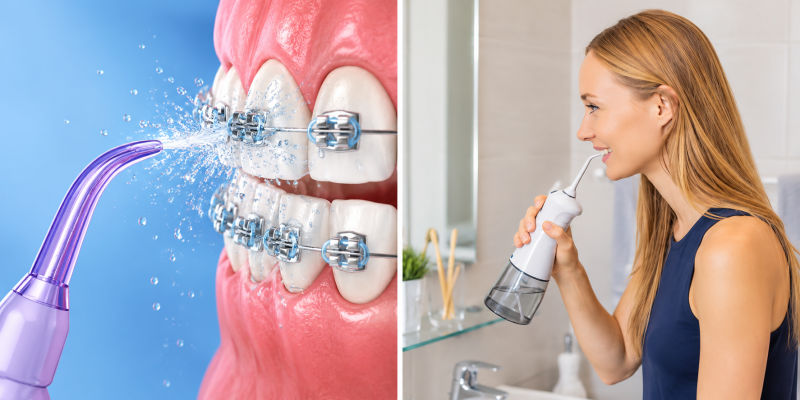
A water flosser (in Spanish irrigador bucal) is a device that sprays a fine pulsating jet of water into the mouth. The pulsation and pressure wash away food debris and loosen soft plaque where bristles cannot reach: between the teeth, in the gum sulcus, under the pontic of a bridge, around a crown on an implant.
The device is simple: a water reservoir, a pump and a nozzle. The pump creates pressure and the nozzle directs the jet. Pressure is adjustable: the more sensitive the gums, the lower the setting should be.
The main rule. The jet does not remove hard plaque or tartar. That is why the water flosser is the last step in oral hygiene: brush → interdental brush or floss → water flosser.
What the research says
Water flossers are often advertised with claims like "removes 99% of bacteria". The scientific data are more modest but support the water flosser as an addition to the toothbrush. The largest review on interdental hygiene was published by Cochrane in 2019: 35 studies, almost 4000 adult participants. The conclusion: a water flosser together with toothbrushing may reduce gum inflammation (gingivitis) in the first month. The authors rated the certainty of this evidence as low, and there is no robust evidence of long-term effect.
With implants the picture is more interesting. A randomised trial at Tufts University (2013) included patients with inflammation of the mucosa around implants. At 30 days, bleeding was reduced around 81.8% of implants in the water flosser group and around 33.3% in the floss group. The device manufacturer took part in the study, which has to be taken into account. A 2025 systematic review in BDJ Open also showed that, around implants, a water flosser reduced bleeding better than floss and interdental brushes.
An important caveat: a 2025 meta-analysis in the International Journal of Implant Dentistry found no significant difference around implants between brushing alone and brushing with a water irrigator. Conclusion: the water flosser is better than floss where floss works poorly — under bridges, around implants, between braces — but it complements the brush, not replaces it.
Who needs a water flosser most
Almost any adult can use a water flosser, but in three situations it is particularly useful:
Plaque at the implant neck causes gum inflammation (mucositis) and, without treatment, bone loss around the implant (peri-implantitis). The jet cleans the sulcus around the crown from all sides.
Food accumulates under the pontic of a bridge. Floss is passed with a floss threader, and the water flosser cleans that area in seconds.
Wires and brackets trap food, and the brush and floss pass under the arch with difficulty. The jet washes away food debris around each bracket.
The water flosser is also useful if you have had periodontal treatment and your specialist has recommended reinforced home hygiene, or if using floss is difficult due to arthritis or crowded teeth.
When not to use it or when to wait
- you have recently had a tooth extracted, an implant placed or gum surgery: the jet can damage the clot and stitches, so the surgical area is not irrigated until the surgeon allows it;
- your gums bleed heavily, hurt or swell: this is a sign of inflammation that needs treatment, and the water flosser will not remove the cause;
- you are prescribed antibiotics before dental procedures (for example, with a prosthetic heart valve): discuss the water flosser with your dentist and cardiologist.
If your gums bleed slightly in the first days, lower the pressure but do not abandon oral hygiene. If the bleeding persists for more than two weeks, an examination is needed.
Water flosser, floss or interdental brush: what to choose
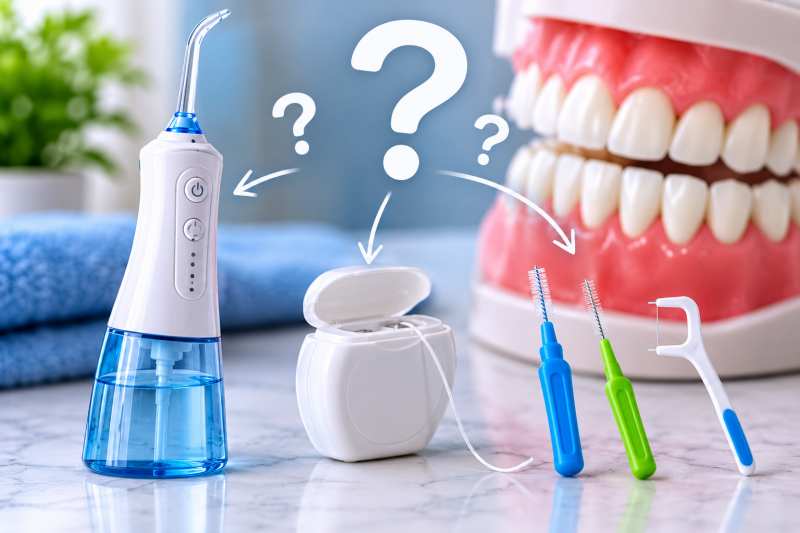
They are not competitors but tools for different tasks. The interdental brush mechanically scrapes away plaque, and the water flosser washes away what the brush cannot reach.
| Tool | Best for | Limitations |
|---|---|---|
| Interdental brush | Wide spaces, side walls of teeth and implants | Size must be chosen; does not pass through very narrow spaces |
| Dental floss | Narrow contacts between natural teeth | Requires skill; under a bridge, a floss threader |
| Water flosser | Implants, bridges, braces, the gum sulcus | Does not remove hard plaque; needs a socket or charge |
Which combination suits you depends on the width of the spaces and on the structures in your mouth. At a preventive check-up the dentist will assess the condition of your gums and tell you which areas to focus on at home.
How to use a water flosser: step by step
- Brush your teethWith a toothbrush and interdental brushes or floss. The water flosser completes the routine.2–3 min
- Fill with warm waterAt room temperature or slightly warmer: cold water is unpleasant for sensitive teeth.
- Set the lowest modeIncrease pressure gradually, over several days, as you feel comfortable.
- Lean over the sinkLips slightly parted, not fully closed, so the water flows freely. Turn the device on with the nozzle already in your mouth.
- Guide the jet along the gum lineAt a right angle to the tooth, along the gum line, from the back teeth to the front, pausing 2–3 seconds in each space, on the outside and the inside.1–2 min
- Implants and bridges — separatelyGo around each crown on an implant in a circle, rinse under the bridge from both sides.+30 sec
What liquid to fill the water flosser with
The main liquid is ordinary warm water. Most studies tested water flossers with it, including those in patients with implants. In many Spanish cities the water is hard. If a white limescale deposit appears in the reservoir or on the nozzle, use filtered or bottled water.
- Mouthwash — only if the device manual allows it, and preferably diluted in water
- Chlorhexidine solutions — only in short courses as prescribed; with prolonged use they stain teeth and fillings
- Salt or herbal "homemade" solutions — do not use them: they clog the pump and nozzles, and their benefit is not proven
- After any solution other than water, run half a reservoir of clean water through the device
How to choose a water flosser in Spain
At the pharmacy or electronics shop, ask for an irrigador bucal or irrigador dental. The choice starts with the question of where you will use it.
Large reservoir, stable pressure, several modes. Convenient for the whole family.
Battery-powered and fits in a bag. Smaller reservoir, sometimes you need to refill.
For implants and bridges — a nozzle with soft bristles at the tip; for braces — an orthodontic nozzle.
- It has smooth adjustment and a genuinely low minimum mode
- Replacement nozzles are sold separately and are easy to find
- The reservoir detaches and can be washed
- For a portable model — battery capacity and USB charging
How to care for the device
- After each use, empty the remaining water and leave the reservoir open so it dries
- Every 1–2 weeks wash the system as the manufacturer's manual specifies, and remove limescale with the product it recommends
- Change the nozzle roughly every 3–6 months, or earlier if the tip has deformed
- Store the device and nozzles dry; each family member has their own nozzle
Do you have implants, a bridge or crowns?
Structures need a check-up every six months. At a check-up at AP-Denta we will examine the gums around implants and crowns, the fixation of the structures and, if needed, carry out a professional hygiene session. We speak Russian, Spanish and English.
FAQ
Can I use a water flosser every day?
Yes. One session a day is usually enough, in the evening after brushing. With braces, the water flosser is convenient after every meal.
Can a water flosser replace floss or an interdental brush?
Not completely. An interdental brush and floss mechanically remove plaque from tooth walls, while the jet mostly washes it away and loosens it. The best result comes from a toothbrush, interdental brush and water flosser together. If using floss is difficult for you, the water flosser is a good alternative, but it does not replace the brush.
Do I need a water flosser if I have implants?
It is highly desirable. Inflammation around an implant starts with plaque at the neck of the crown, and cleaning that area with a brush is difficult. In studies, the water flosser reduced bleeding around implants more than floss. Around a fresh implant the water flosser is started when the doctor allows it.
When can I use a water flosser after a tooth extraction or implant placement?
Only once the surgeon allows it. In the first days the jet can wash the clot out of the socket or damage stitches. Brush the rest of your teeth as usual, and do not touch the surgical area with the water flosser until the follow-up check-up.
Why do my gums bleed when I use a water flosser?
Most often the gums are already inflamed, and the jet simply reveals it. Lower the pressure and continue daily oral hygiene: with regular care the bleeding usually decreases. If it lasts more than two weeks, or there is pain or swelling, book a check-up.
Can I put mouthwash in a water flosser?
Yes, if the device manual permits it, and preferably diluted with water. For everyday use, warm water is enough. Therapeutic solutions, such as chlorhexidine, are used in short courses as prescribed.
Sources
- Worthington H.V. et al. Home use of interdental cleaning devices, in addition to toothbrushing, for preventing and controlling periodontal diseases and dental caries. Cochrane Database of Systematic Reviews, 2019, CD012018. doi:10.1002/14651858.CD012018.pub2
- Magnuson B. et al. Comparison of the effect of two interdental cleaning devices around implants on the reduction of bleeding: a 30-day randomized clinical trial. Compendium of Continuing Education in Dentistry, 2013; 34 (suppl. 8).
- Gandi G. et al. Efficacy of oral irrigators compared to other interdental aids for managing peri-implant diseases: a systematic review. BDJ Open, 2025; 11: 7. doi:10.1038/s41405-025-00301-3
- Optimizing implant hygiene: the added value of interproximal cleaning devices around implant-supported restorations — a systematic review and meta-analysis. International Journal of Implant Dentistry, 2025; 11: 64. doi:10.1186/s40729-025-00652-4
+(34) 638 893 141
Mon–Fri 10:00–20:00. WhatsApp will open with the chosen day and time.
Contraindications apply. A specialist consultation is required. The article is for information only and does not replace a dental examination.