
Author: Marina Peterson, orthopedic dentist at AP-Denta clinic, Torrevieja, Costa Blanca. Publication date: July 2, 2026.
Want to improve your smile with veneers?
At AP-Denta, we study each case during the initial consultation and explain which type of veneer suits your teeth best. No obligations and no waiting lines.
WhatsApp: +(34) 638 893 141
Torrevieja, Pasaje País Vasco, edificio 1, local 4
apdenta@gmail.com · Mon–Fri 10:00–20:00, Sat–Sun — closed
In brief
A veneer is an ultra-thin shell less than one millimeter thick, which an orthopedic dentist bonds to the visible surface of a tooth to change its color, adjust its contour, or close a gap between teeth. There are two main types: composite veneers, applied directly in the chair over one to two visits and lasting 4–8 years, and ceramic veneers — made of porcelain, lithium disilicate, or zirconium dioxide — fabricated in a laboratory and designed to last 10–20 years. Before recommending this treatment, orthopedic dentist Marina Peterson rules out contraindications: uncontrolled bruxism, active gum disease, and insufficient enamel for reliable adhesion.
What veneers solve where other methods are powerless
When a patient wants to lighten their teeth, the first thought is bleaching. However, there are types of pigmentation that this method does not address: darkening from tetracyclines or fluorosis develops inside the enamel, not on its surface, and remains untouched even after several gel sessions. In such cases, placing a veneer closes the problem in two visits where no bleaching agent would yield results. Likewise, a diastema — a gap between the central incisors — can be closed with braces over several months or with veneers over several weeks; the choice between the two depends on the gap width, the condition of the rest of the dentition, and the patient's priorities. Veneers are also used when the incisal edge of a front tooth has gradually worn down over the years, or when the shape of several teeth is irregular and the smile's appearance needs to be evened out without resorting to crowns.
When veneers work, and when other treatment is needed first
Before deciding on veneers, the doctor checks four things: gum condition, the amount of available enamel, the bite, and the presence of bruxism. In active periodontitis — bleeding, deep pockets, tooth mobility — any aesthetic restoration is postponed until the infection is resolved. If the enamel is severely thinned due to acid erosion or if the tooth has already been significantly ground down in the past, acid etching for veneer bonding will not provide a sufficient foundation, and adhesion will fail over time. Bruxism creates shear forces that no ceramic can withstand without protection: if such a habit exists, a night guard is fitted first, and only after the situation stabilizes is the possibility of veneers considered.
| Veneers solve the problem | Other treatment is needed first |
|---|---|
| Internal discolorations from tetracyclines or fluorosis that do not respond to bleaching | Active periodontitis: inflamed gums, bleeding, or bone loss |
| Diastemas — small or moderate gaps between front teeth | Uncontrolled bruxism: nighttime clenching can destroy ceramics within months |
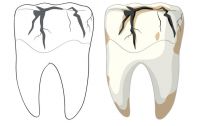
| Superficial chips and cracks on front teeth with preserved internal structure | Insufficient enamel: without an enamel base, cement will not provide reliable adhesion |
| Worn incisal edge affecting smile aesthetics | Unsatisfactory oral hygiene: increased risk of caries under the veneer margin |
| Irregular shape or size of several teeth that need to be unified | Severely destroyed tooth: in such cases, a crown provides a more predictable outcome |
Composite or ceramic: how to make the right choice
The choice between the two materials is not determined solely by budget. A composite veneer is created by the doctor directly in the oral cavity without laboratory involvement: in one visit, the enamel is etched, the material is applied in layers, the tooth anatomy is modeled, and it is cured with a polymerization lamp. The result is visible immediately, and if removal ever becomes necessary, the tooth remains virtually unchanged because the enamel is almost untouched. The downside: the composite surface is more porous than ceramic and over time absorbs pigments from coffee, wine, and tea; by the fourth to fifth year, polishing or replacement is typically required.
A ceramic veneer is created in a dental laboratory based on a three-dimensional scan of the oral cavity. The dental technician designs each shell on a computer and mills or hand-layers it depending on the chosen material: traditional porcelain, lithium disilicate — which most accurately mimics the translucency of natural enamel — or zirconium dioxide, whose hardness surpasses both of the former. The glassy surface of ceramics does not absorb dyes, thus maintaining its color for ten years and beyond. This comes at another cost: to place a veneer, a thin layer of enamel must be removed — from 0.5 to 1 millimeter — and this is irreversible.
| Criterion | Composite · Ceramic (porcelain / lithium disilicate / zirconium dioxide) |
|---|---|
| Average lifespan | 4–8 years · 10–20 years (porcelain, disilicate); 15+ years (zirconium dioxide) |
| Stain resistance | Moderate: resin absorbs dyes over time · High: glassy surface does not pigment |
| Aesthetics | Good · Very high; lithium disilicate best reproduces enamel translucency |
| Tooth preparation | Minimal or none · Requires removal of 0.5–1 mm of enamel (irreversible) |
| Reversibility | Yes, the tooth remains almost untouched · No, preparation is permanent |
| Number of visits | 1–2 visits (all in the chair) · 2–3 visits (with laboratory stage) |
| Approximate price per tooth | €115–200 · €245–475 depending on material and clinic |
| Optimal choice when... | Quick results with lower initial investment are needed · Longevity and maximum aesthetics for years ahead are priorities |
How the treatment proceeds: from the first visit to final bonding
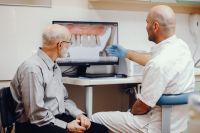
The first appointment is always diagnostic: the doctor checks the gums, enamel, and bite, takes photographs, and in many cases performs a mock-up — a temporary composite simulation directly in the mouth — so the patient can see an approximate result before any preparation. When composite is chosen, the second appointment is already final: enamel etching, layered application and modeling of the material, polymerization, bite adjustment — all in one visit.
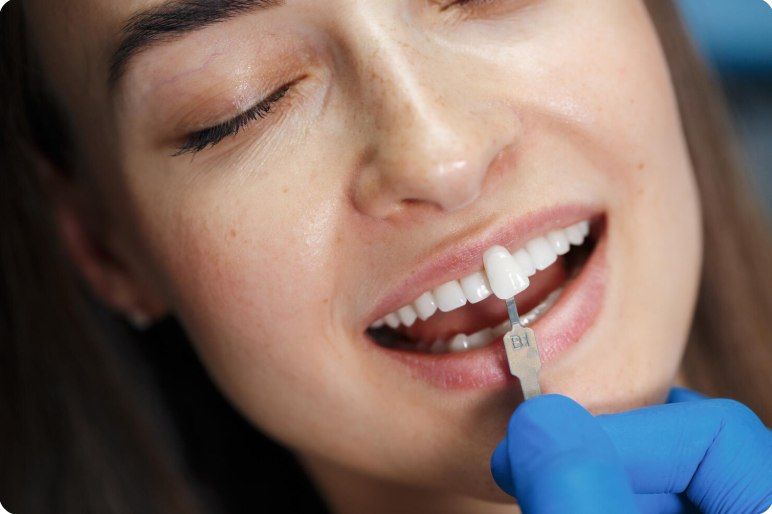
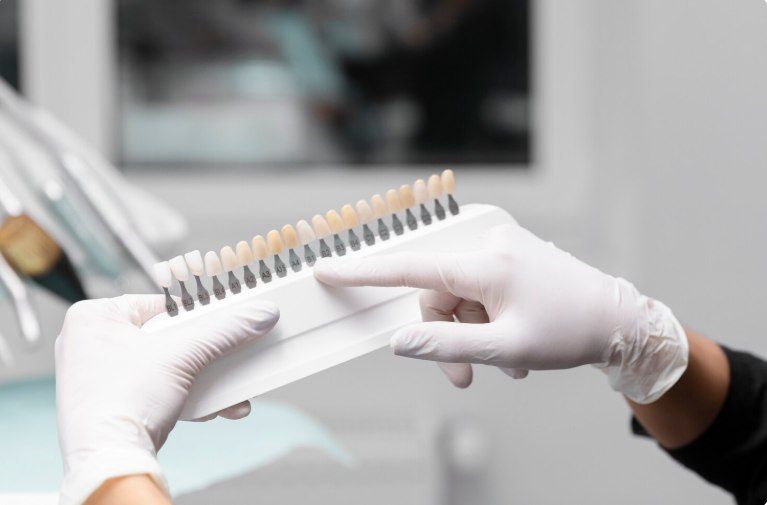
If ceramic is selected, the second visit includes tooth preparation under local anesthesia, digital scanning, and placement of temporary veneers, which the patient wears for one to two weeks while the laboratory fabricates the permanent ones. At the third appointment, a try-in is performed: the shells are tried on without bonding, the shade is verified against a color scale, and occlusion is checked. If everything is satisfactory, the veneers are bonded with high-strength adhesive cement, and the margins are polished so that the transition between the shell and the tooth is imperceptible to both touch and sight.
How to care for veneers to make them last longer
Ceramics do not stain, but they can chip under loads for which they are not designed. The habit of chewing pens, opening packages with teeth, or crunching ice shortens the life of any ceramic restoration. For patients with bruxism, a night guard becomes a mandatory accessory from the first day after placement: without it, any longevity guarantees lose meaning. For maintenance, a regular toothbrush, floss, and water flosser are sufficient; toothpastes with a high abrasivity index should be avoided with composite veneers — they scratch the surface and accelerate pigmentation. Check-ups every 6–12 months allow early signs of wear or micro-cracks to be detected long before full replacement becomes necessary.

Veneers at AP-Denta, Torrevieja
Orthopedic dentist Marina Peterson works with composite and ceramics — porcelain, lithium disilicate, and zirconium dioxide — and performs a smile analysis with a mock-up at the first appointment, before any decision about preparation is made. The AP-Denta clinic welcomes patients from Torrevieja and neighboring towns in the province of Alicante, with consultations available in Spanish, Russian, and English. This is organizational information about the clinic, not part of the clinical recommendations above.
Questions and answers
Do veneers permanently harm the tooth?
Composite veneers are bonded with virtually no preparation, so if they are removed, the tooth remains almost as it was, and the treatment is considered reversible. Ceramic veneers require removal of 0.5–1 mm of enamel so that the shell does not create excessive bulk: this tissue does not regenerate, and from then on, the tooth will always need some type of restoration on that surface.
How many years do veneers actually last?
Composite ones, with proper hygiene and regular check-ups, last 4–8 years, after which polishing or replacement is required. Porcelain or lithium disilicate ceramics in most cases last 10–15 years, and often up to 20; zirconium dioxide veneers last 15 years and more due to their enhanced hardness. In all cases, longevity is most strongly affected by bruxism control and avoiding the habit of chewing hard objects.
Why can't a darkened veneer be whitened?
Hydrogen peroxide in bleaching gels acts on organic pigments in natural enamel — neither ceramics nor composite have such a structure, so the gel has no effect on them. A darkened composite veneer over time is polished or replaced. This is precisely why the final shade of veneers must be agreed upon before bonding: natural teeth adjacent can be whitened later, but the color of an already placed veneer will not change.
Can veneers be placed with bruxism?
Bruxism is a relative, not absolute, contraindication. First, the habit is brought under control: most often this involves a night guard and, if necessary, botulinum toxin injections into the masticatory muscles. When the situation is stable, veneers can be placed — but the night guard becomes a mandatory part of care on an ongoing basis to protect the ceramics during sleep.
How many visits are needed and how long does the entire process take?
With composite, everything fits into one or two visits within the same week. With ceramic, the process takes three appointments: first — diagnostics and mock-up, second — preparation and digital scanning, third — try-in and final bonding. Between the second and third appointments, the laboratory fabricates the veneers — usually one to two weeks; during this period, the patient wears temporary shells.