

Tooth decay treatment in Torrevieja
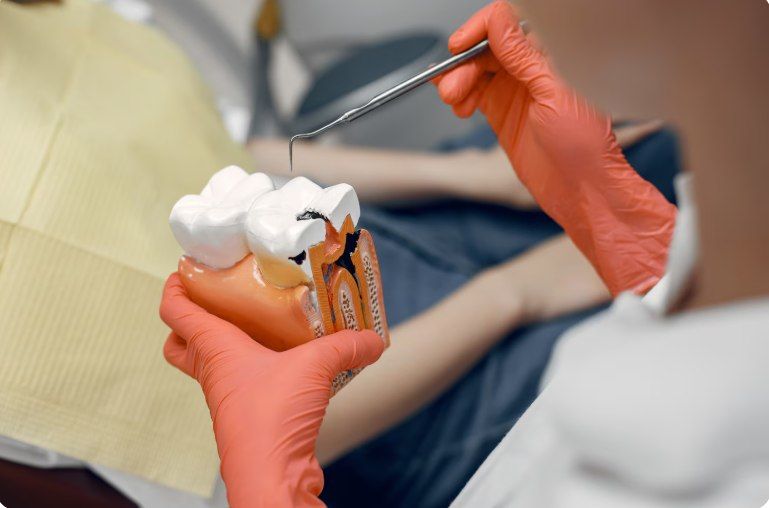
Tooth Decay Treatment
Table of Contents
- Causes of tooth decay
- Consequences of tooth decay
- Presentations of tooth decay
- Treatment of tooth decay
Causes of Tooth Decay
Tooth decay is a process of destruction of the hard tissues of the tooth, resulting in the formation of a cavity within the tooth. One of the causes of tooth decay is the action of acids produced by the metabolic activity of bacteria in the oral cavity.
This condition develops when food debris is not removed from the tooth surfaces, particularly from the gingival margin and contact areas between teeth. This food debris putrefies and turns into plaque. Plaque harbours bacteria that produce acid, which erodes the tooth structure. The result is a defect — tooth decay. This is why proper oral hygiene plays the single most important role in the prevention of decay. Diet, environmental factors and underlying health conditions also have an influence.
Consequences of Tooth Decay
If tooth decay is not treated promptly, the infection reaches the neurovascular bundle, causing inflammation — pulpitis and periodontitis — accompanied by severe pain and/or swelling of the gum. In such cases it is no longer possible to keep the tooth vital, and endodontic treatment becomes necessary (removal of the nerve, canal preparation and obturation), followed by restoration of the tooth with prosthetic structures — post-and-core build-ups and crowns.
Furthermore, teeth left untreated become a source of infection that spreads throughout the entire body. The patient is effectively being exposed to their own decayed teeth, bacteria and putrefying food debris on an ongoing basis. This contributes to the development and perpetuation of diseases of the ENT organs, the stomach, kidneys, liver and heart. This is precisely why dentists strongly advise attending the clinic on a regular basis, so that treatment can begin as early as possible.
Tooth decay is equally dangerous in milk teeth. If you notice decay in your child's teeth, it is essential to bring them to see a dentist. Although the milk teeth will eventually be replaced, complications arising from untreated decay in children can damage the developing permanent tooth bud. To help prevent decay in children's permanent teeth, fissure sealants can be applied as a preventive measure.
Presentations of Tooth Decay
Tooth decay is classified by the depth of tissue involvement as follows:
- White spot stage. Decay affects only the superficial layer of enamel. It presents as a faint yellow or white spot that is barely visible to the naked eye.
- Superficial decay. The enamel of the tooth is affected; the surface becomes rough and uneven. It may appear as a white or brown spot.
- Moderate decay. The dentine of the tooth is involved. At this stage a carious cavity — a "hole" — develops, which becomes visible to the naked eye.
- Deep decay. Here the involvement of the dentine is deep and extensive. It extends close to the neurovascular bundle of the tooth and can cause severe pain, as well as inflammation of the nerve — pulpitis.
Very often tooth decay causes the patient no discomfort whatsoever and does not look as one might expect — as a "black hole" — meaning that the patient only becomes aware of the problem during a routine dental examination, or by the time the infection has already reached the nerve and the tooth has begun to ache.
Following the examination, we explain, describe and show the patient the stage of the process and the treatment approach.
Treatment of Tooth Decay
We use the following modern technologies in the treatment of tooth decay:
- ICON technology is used at the superficial decay stage. The tooth tissue is treated with a special preparation — a resin. This is a method of caries infiltration that requires no drilling and causes no pain.
- Tooth filling is carried out for moderate and deep decay, as well as for wedge-shaped defects. The cavity is drilled out and filled. We use the most advanced light-cured restorative materials, which not only allow us to restore the anatomical form of the tooth, but also to create aesthetic, strong and long-lasting restorations.
- Inlays — restoration of lost tooth tissue using "fillings" made from ceramic or precious metal alloys.
Timely attendance at the dentist, regular hygiene and preventive care will help you avoid serious dental disease and the need for prosthetic treatment, which can involve considerable expense.
We invite residents of Torrevieja, La Mata, Elche, Murcia, Alicante and other towns along the Costa Blanca and in the Valencia region to visit our clinic or to give us a call. CALL US: +(34) 638 893 141. Appointments are by prior arrangement only.
Contact Information:
| Torrevieja, Pasaje Pais Vasco, edificio 1 local 4 | |
| +(34) 638 893 141 | |
| +(34) 638 893 141 | |
| apdenta@gmail.com | |
| Working hours: Mon - Fri: from 10:00 to 20:00 |