
Is your tooth broken or chipped right now?
At AP-Denta, patients with acute dental trauma are seen on the day of their call. Write or call — the reception desk will advise you on what to do before your appointment.
WhatsApp: +(34) 638 893 141
Torrevieja, Pasaje País Vasco, building 1, local 4
apdenta@gmail.com · Mon–Fri 10:00–20:00, Sat–Sun — closed
In brief
The type of tooth damage determines both the urgency and the restoration method: a chip limited to enamel rarely requires an immediate visit, but exposed pulp or tooth mobility is a reason to see a dentist the same day. Before your appointment, rinse your mouth with room-temperature water, if possible keep the broken piece in a moist environment, and do not touch the damaged area with your tongue or hands. The doctor will devise the treatment plan during the examination — from polishing the edge and composite restoration to root canal treatment with anesthesia and crown placement.

Why teeth are damaged more often in Torrevieja in summer
During the tourist season, the number of dental trauma cases rises noticeably: a chin hitting the edge of a swimming pool while diving, a fall from a bicycle on the promenade, a shell or pit in a dish on a beach terrace, heads colliding during water games. Add to this the holiday habit of opening bottles with teeth, crunching ice in cocktails, or wrestling with mussel shells and shrimp in paella — in unfamiliar surroundings, such little things happen more often than at home.
Causes of tooth damage
A tooth can break even without a blow or fall. Enamel is the hardest tissue in the human body, but beneath it lie softer dentin and pulp, and if the enamel is thinned by extensive decay, a wedge-shaped defect at the neck of the tooth, or an old filling, the pressure of normal chewing can cause the crown to fracture. Nighttime bruxism — grinding and clenching teeth during sleep — gradually wears down and weakens enamel, and the habit of cracking nuts, seeds, and hard candies only accelerates this process. In children, injuries during active play are more common; in adults, falls from bicycles, scooters, or e-scooters are especially frequent during holiday periods.
Types of tooth chips and fractures
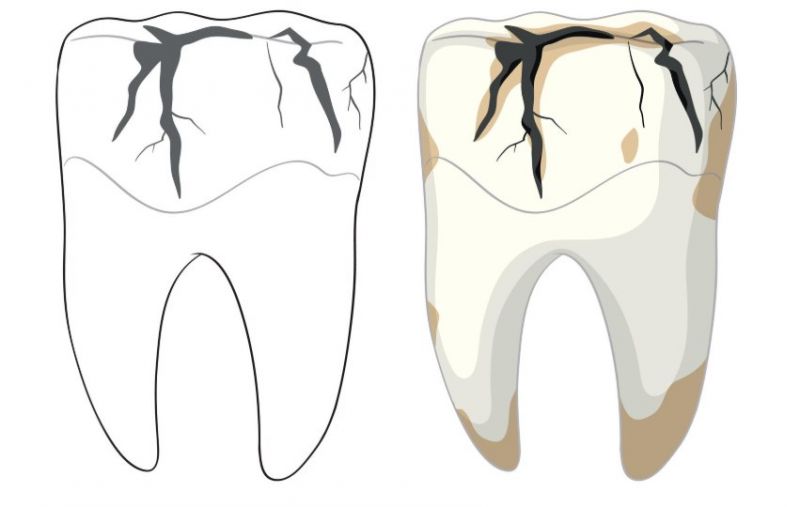
Injuries are usually classified by the depth of the tissues involved. Enamel chip — the most superficial and usually painless; exposed dentin makes the tooth acutely sensitive to cold, hot, and sweet — a condition called hypersensitivity; exposed pulp is accompanied by pronounced pain and a visible pink dot or bleeding inside the tooth. A separate category includes crown fracture, root fracture — which is not always visible from the outside — and complete avulsion, when the tooth comes entirely out of the socket.
| Type of damage | How to recognize |
|---|---|
| Enamel chip | No pain, the edge is smooth or slightly sharp, sometimes only detectable by the tongue |
| Exposed dentin | Sharp reaction to cold, hot, sweet (hypersensitivity) |
| Exposed pulp | Throbbing pain, visible pink dot or bleeding inside the tooth |
| Crown or root fracture | Pain when biting, mobility or displacement of the tooth |
| Complete avulsion | The tooth is absent from the socket, the socket is bleeding, sometimes the root is visible |
What to do before seeing a dentist
First, rinse your mouth with room-temperature water — this will wash away blood and small fragments and help you assess the extent of the damage. Do not rub or dry any tooth fragment you find — place it in saliva, milk, or saline solution: drying destroys the cells on the root surface that are needed for possible reattachment. Bleeding from the gum can be stopped with clean gauze pressed to the wound for 10–15 minutes, and swelling of the cheek on the injured side can be reduced with a cold compress applied intermittently for 15 minutes at a time. A sharp edge that rubs against your lip or tongue can be temporarily covered with dental wax or sugar-free chewing gum until your visit.
Some actions can do more harm than the injury itself: glue for the broken fragment is a bad idea — household glue is toxic and burns living tissues; do not place a painkiller tablet directly on the gum next to the tooth — that causes chemical burns to the mucosa, not pain relief; and do not poke into the cavity with sharp objects trying to "clean" the tooth. And most importantly — even if it does not hurt at all, that is no reason to put off the visit until "sometime later."
Why you should not delay visiting a doctor
The sooner a patient comes in, the better the prognosis for saving the tooth alive: exposed dentin and especially exposed pulp quickly become entry points for bacteria, and inflammation can progress to an abscess in just a few days. Meanwhile, the sharp edge of the chip cuts the tongue and cheek with every conversation and meal, and a tooth without support from its neighbors gradually shifts, altering the bite and the load on the entire dental arch. On vacation, this is easy to overlook, but the soft tissues and bone continue to react to the trauma regardless of whether it is swimming season or not.
Methods of restoring a broken tooth
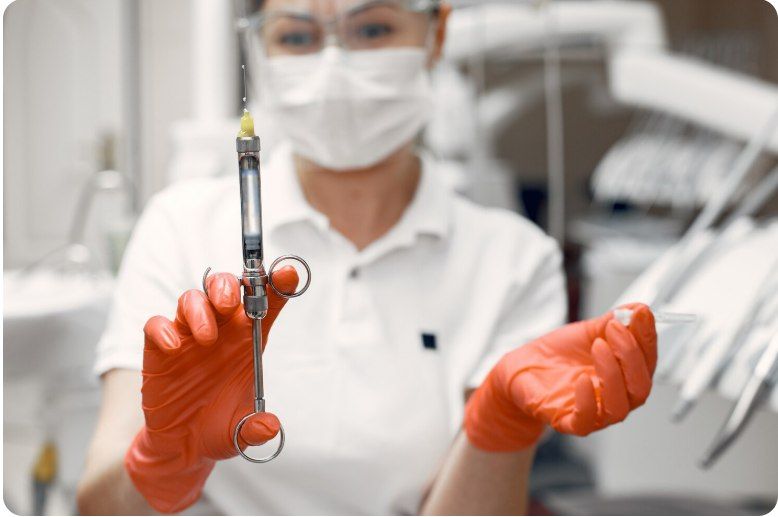
Before beginning treatment, the dentist assesses the depth of the damage and proposes a treatment plan — there is no single scheme for all cases. Small chips of enamel and dentin are most often treated with artistic restoration: the tooth is lightly prepared (a thin layer of tissue is removed to accommodate the material) and the shape is restored layer by layer with composite in a single visit, with natural aesthetic results immediately after the procedure. For a front tooth with a noticeable aesthetic defect, a ceramic veneer may be an alternative. If a significant portion of the crown is destroyed, the tooth is reinforced with a post and restored with a permanent crown — sometimes a temporary restoration is placed in the meantime while the permanent structure is being fabricated. If the pulp is damaged, root canal treatment with anesthesia is performed first, and only then the visible part of the tooth is restored. After any procedure, the dentist usually schedules a follow-up visit to ensure the restoration has healed without complications.
| Type of damage | What to do and how it is treated |
|---|---|
| Enamel chip | Now: rinse mouth, smooth the sharp edge at home with wax At the doctor: polishing or composite restoration |
| Exposed dentin | Now: avoid hot and cold, see a doctor within 1–2 days At the doctor: composite restoration, for front teeth — veneer |
| Exposed pulp | Now: see a doctor on the day of injury At the doctor: anesthesia, root canal treatment, then crown |
| Crown or root fracture | Now: keep the fragment in a moist environment, go to the doctor At the doctor: post with crown, splinting of adjacent teeth, or extraction |
| Complete avulsion | Now: store the tooth in milk, do not touch the root, get to the doctor within 30–60 minutes At the doctor: replantation or prosthetic restoration if time has been lost |
Preventing cracks and chips on vacation and in daily life
Reducing the risk of injury is helped by a mouthguard — during contact sports, trampoline activities, and active games in the pool; the habit of opening packages with your hands rather than your teeth; caution with bones and shells in seafood and with ice in drinks. It is equally important to treat cavities promptly and replace fillings that have lost their strength, and for bruxism — to use a night guard to prevent enamel from thinning during sleep. A preventive check-up with a dentist every six months allows you to spot a weakened area of the tooth before it breaks under normal chewing pressure.
AP-Denta sees patients from Torrevieja and surrounding towns
The clinic is conveniently accessible not only from Torrevieja but also from neighboring towns in the Alicante region: the doctors speak five languages, so both locals and tourists from different countries will be able to explain their situation. This is organizational information about the clinic and not part of the medical recommendations above.
Questions and answers
Can a chipped tooth heal on its own, without a doctor?
No: unlike skin or bone, enamel and dentin do not regenerate on their own. The chip will not disappear or "close up" — over time, chewing pressure can only enlarge the damaged area.
Can the broken piece of a tooth really be useful to the dentist?
Sometimes yes — with large and fresh chips, the dentist may be able to bond the fragment back with composite material if it has been well preserved. But this is more of an additional option: even without the found piece, the tooth can be fully restored with a restoration or crown.
A child's baby tooth chipped — is that serious?
It is worth having the child seen by a dentist in any case, even if the tooth is due to fall out soon: the doctor will check whether the pulp has been affected and whether the permanent tooth bud developing right underneath the baby tooth has been damaged.
Is it dangerous to swallow a tooth fragment?
The fragment itself usually passes safely through the digestive tract. A reason for concern would be severe abdominal pain, difficulty breathing or swallowing; in that case, separate medical attention unrelated to a dental visit is needed.
How long does it take to restore a chipped tooth?
Composite restoration for an enamel or dentin chip usually takes one visit. If the pulp is affected and root canal treatment followed by a crown is required, the restoration may take several appointments — the exact timeline is given by the doctor after examination and X-ray.