

Tooth shattered extractions in Torrevieja
Author: Alexander Peterson, Oral Surgeon at AP-Denta Published: June 12, 2026
Removal of a destroyed tooth or its root is indicated when restoration of the crown portion with a filling, post-and-core, or crown is no longer possible: tissues are destroyed below the gum level, the root is fragmented, or a chronic inflammatory focus — granuloma or cyst — has formed in the bone around the root apex. At AP-Denta in Torrevieja, the decision to extract is made only after an X-ray: it shows whether the root is preserved enough to consider restoration, or whether keeping it poses a risk of infection spreading to adjacent teeth and bone.
When a tooth cannot be restored and extraction is needed
Advanced caries gradually destroys not only enamel but also dentin, reaching the pulp and then the tooth root. If the crown portion is completely destroyed and the remaining fragment is a so-called "tooth stump" without sufficient support, classic restoration with a post-and-core and crown becomes unreliable or impossible. In such cases, a chronic focus — granuloma or cyst — has often already formed around the root apex, which do not hurt on their own but maintain low-grade inflammation in the jawbone.
A separate situation is impacted teeth and wisdom teeth, which due to improper positioning in the jaw injure adjacent teeth or gums, causing overgrowth of surrounding tissues and chronic inflammation. In both cases — both with deep crown destruction and with positional pathology — diagnosis begins with an X-ray or CT: only imaging reveals the actual condition of the root, the bone tissue around it, and the distance to adjacent anatomical structures.
How extraction of a destroyed tooth or root is performed
Simple extraction
Simple extraction is performed when the crown portion of the tooth or its root is accessible and sufficiently mobile to be removed with forceps under local anesthesia in a single short procedure. Suitable for teeth with destruction limited to the crown portion and for roots that are not fragmented into separate pieces.
Surgical extraction
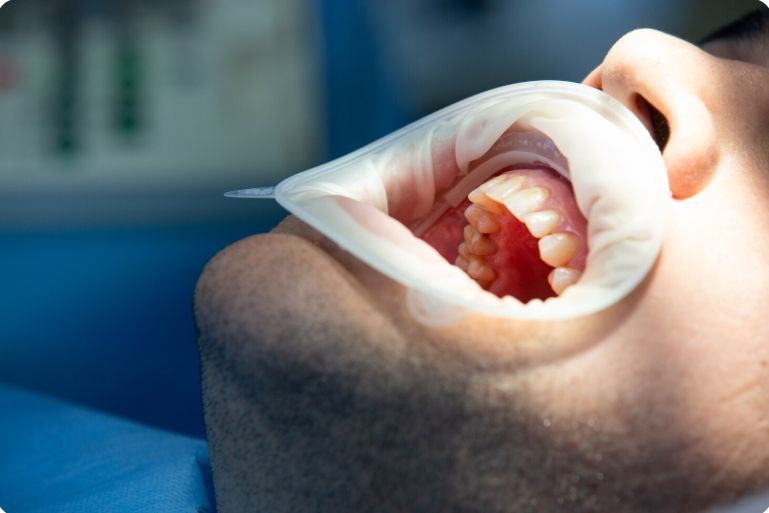
Surgical extraction is required if the tooth root is fragmented into several pieces, if the tooth is impacted (not fully erupted), or if infected tissues have already grown around it. In this case, the surgeon may divide the roots into parts, partially remove bone to access a deeply located fragment, or remove overgrown soft tissues around the socket — the procedure takes longer and is performed by an oral surgeon.
Anesthesia
Most extractions, including surgical ones, are performed under local anesthesia, which completely blocks sensation in the intervention area. In cases of high anxiety, pronounced gag reflex, or patients with neurological disorders requiring special care, sedation or medication-induced sleep is considered — this is discussed at the diagnostic stage, not in the chair immediately before the procedure.
Contraindications and limitations
Extraction is postponed or performed with additional precautions in acute infectious diseases, including respiratory infections and elevated body temperature, in blood clotting disorders, in decompensated diabetes mellitus, and also in the first and third trimesters of pregnancy — in these cases, the decision is made individually, in consultation with the patient's attending physician. For oral cavity neoplasms, extraction is possible only after additional diagnostics of the cause of the formation.
What happens if a destroyed tooth is not removed
If a destroyed tooth with chronic bone inflammation is not removed and treated, the infection can spread to adjacent teeth and gum soft tissues, and in rare cases, become the cause of a more serious inflammatory process requiring urgent care. The absence of a tooth without subsequent prosthetics or implantation also does not remain without consequences: bone tissue in that area eventually atrophies due to the lack of habitual chewing load, and adjacent teeth gradually shift into the resulting gap, altering the bite.
After extraction: the restoration plan
Bone atrophy is especially important if implant placement is planned in the future: the longer the socket remains without load, the higher the likelihood that a separate bone grafting procedure will be needed before implant placement, which increases both the time and scope of treatment. Therefore, at AP-Denta, the plan for the post-extraction period — whether to place the implant immediately, allow the socket to heal, or consider a bridge — is discussed in advance, before the extraction itself, not after it.
Simple and surgical extraction: comparison
| Criteria | Comparison |
|---|---|
| When applied | Simple: the tooth or root is accessible and retains mobility. Surgical: the root is fragmented, the tooth is impacted or surrounded by overgrown tissues. |
| Method | Simple: extraction with forceps. Surgical: division of the root into fragments, partial bone access. |
| Visit duration | Simple: short procedure, one visit. Surgical: requires more time in the chair with an oral surgeon. |
| Performed by | Simple: oral surgeon following standard protocol. Surgical: oral surgeon, with sedation when indicated. |
| Follow-up care | Simple: standard socket healing period. Surgical: may require a follow-up examination due to the greater extent of bone intervention. |

Frequently asked questions about removal of destroyed teeth
Is it painful to remove a severely destroyed tooth?
Modern anesthetics completely block sensation in the intervention area, so the extraction itself should not cause pain. For surgical extraction or in cases of high anxiety, sedation is possible and is discussed in advance, at the diagnostic stage.
Is an X-ray necessary before extraction?
Yes, an X-ray or CT is mandatory before extraction: it shows the condition of the root, surrounding bone tissue, and the distance to adjacent anatomical structures, and allows us to determine in advance whether the extraction will be simple or surgical.
Can an implant be placed immediately after extraction?
In some cases this is possible, but the decision is made individually, depending on the condition of the socket and surrounding bone after extraction. If there is a risk of bone atrophy, the plan may include a healing period or preliminary bone grafting.
If a tooth is destroyed down to the root, does it definitely have to be removed?
Not always — if the remaining root portion is sufficient for reliable support, restoration with a post-and-core and crown is considered. The decision depends on the volume of remaining tissues and the condition of the tissues around the root, which is only visible on imaging.
In what conditions is tooth extraction postponed?
Extraction is postponed in acute infectious diseases, including respiratory infections and elevated body temperature, in blood clotting disorders, and in decompensated diabetes mellitus. In the first and third trimesters of pregnancy, the decision is made individually, in consultation with the patient's attending physician.
Contact Information:
| Torrevieja, Pasaje Pais Vasco, edificio 1 local 4 | |
| +(34) 638 893 141 | |
| +(34) 638 893 141 | |
| apdenta@gmail.com | |
| Working hours: Mon - Fri: from 10:00 to 20:00 |