
Want to correct your bite with metal braces?
At AP-Denta, we perform diagnostics during your first visit and create a treatment plan tailored to your specific case. No waiting in lines. We speak Russian, Spanish, and English.
Book via WhatsApp: +(34) 638 893 141
Torrevieja, Pasaje País Vasco, building 1, local 4
apdenta@gmail.com · Mon–Fri 10:00–20:00, Sat–Sun — closed
In short
Metal braces remain in 2026 the most common fixed orthodontic system in Spain: they correct both mild bite disorders and complex pathologies, while costing significantly less than ceramic systems and aligners. Treatment takes 12 to 24 months depending on the clinical picture, with check-ups every 4–6 weeks. Self-ligating models — with a metal clip instead of a rubber ligature — transfer archwire force more evenly, which in some cases shortens overall treatment time. At AP-Denta, Torrevieja, the treatment plan is developed using an intraoral digital scanner already during the first visit.
Why metal braces remain the number one choice in 2026
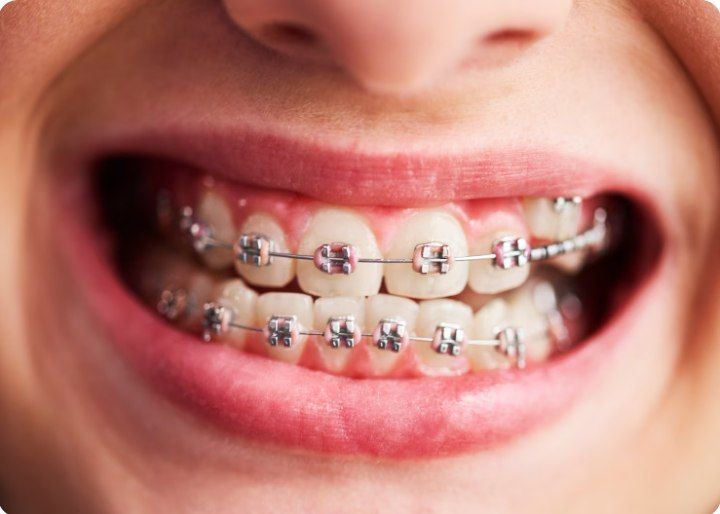
Every year, new orthodontic systems appear on the market, yet metal braces maintain their leading position for one specific reason: no other system combines the same range of correction, predictable results, and affordable cost. They are made from high-strength stainless steel — with titanium used in some models to reduce weight — and are bonded directly to the enamel using modern-generation dental adhesive cement. The metal archwire connecting the brackets serves as a constant guiding element: it applies controlled forces to each tooth, gradually moving it into the planned position.
In self-ligating models, the archwire is held by a built-in metal clip rather than a rubber ligature: eliminating this contact point reduces mechanical resistance and ensures more even force transfer. In practice, this allows for longer intervals between visits and, in some cases, shorter overall treatment duration.
Metal braces are suitable for patients of any age. For adults, they correct bite disorders that were not addressed in childhood. For children, braces are installed from the age of 7–8 — provided there are enough permanent teeth for reliable fixation.
Unlike removable systems, braces work continuously and do not depend on patient discipline. In treatments lasting more than 18 months, this continuity is what determines the predictability of the final result: every hour without aligners is an hour without corrective force applied.
What problems do metal braces correct
Metal braces address virtually any bite anomaly: crowding and diastemas (gaps between teeth), crossbite — anterior and posterior, open bite, deep bite, and prognathia. They are particularly effective in severe cases where aligners are less effective, and allow the simultaneous use of intermaxillary elastics where correction of both arches is needed. For purely aesthetic concerns without functional disorders, the orthodontist may consider a removable system, but when precise and continuous correction is required, metal braces remain the system with the strongest evidence base in clinical literature and the standard for specialist training according to the Spanish Society of Orthodontics and Dentofacial Orthopedics (SEODF).
| Criterion | Metal · Sapphire · Aligners (clear aligner therapy) |
|---|---|
| Correction capabilities | Very high, including complex cases · High · Medium-high, limited in severe pathologies |
| Aesthetics during treatment | Visible, metallic color · Discreet, tooth-colored · Nearly invisible |
| Relative cost | Most affordable · Medium (20–40% more expensive) · Highest |
| Average treatment duration | 12–24 months · 12–24 months · 6–18 months (mild to moderate cases) |
| Visit frequency | Every 4–6 weeks · Every 4–6 weeks · Every 6–8 weeks |
| Patient discipline required | No: fixed 24/7 · No: fixed 24/7 · Yes: at least 22 h/day |
| Structural reliability | Very high, rarely break · High, more fragile than metal · High, but trays can be lost or deformed |
| Suitable for children and adolescents | Yes, from age 7–8 · Yes · Not recommended before age 14 |
How metal braces treatment works at AP-Denta
Treatment does not begin with the placement of braces, but with a thorough diagnosis. At AP-Denta, we use an intraoral digital scanner: it captures accurate models of dental arches without the need for impression material, making the procedure comfortable and allowing the orthodontist to plan the movement of each tooth before any active treatment begins. Based on the scan results, the orthodontist creates a treatment plan, outlines the expected timeline, and answers all patient questions before any decision is made.
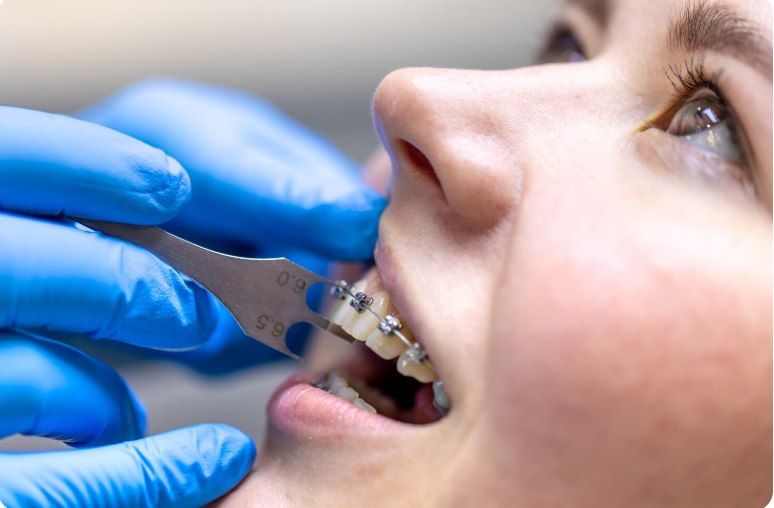
Bracket placement takes 60 to 90 minutes: the working field is isolated, the enamel is etched with orthophosphoric acid, adhesive is applied, and each bracket is bonded with millimeter precision. Then the initial archwire is inserted — with minimal force to ensure initial movement is gradual and painless. During subsequent check-up visits — every 4–6 weeks — the archwire is replaced with a stiffer one as the teeth respond to the forces applied.
| Stage | What happens and how long it takes |
|---|---|
| 1. Diagnosis and planning | Intraoral scanning, X-rays, photodocumentation. Orthodontist creates a full treatment plan. Duration: 1 visit |
| 2. Bracket placement | Enamel etching, bracket bonding, initial archwire insertion. Duration: 60–90 minutes |
| 3. Active correction phase | Visits every 4–6 weeks with sequential archwire changes. Duration: 12–22 months depending on the case |
| 4. Bracket removal and retention | Braces are removed, and a fixed or removable retainer is placed to maintain the result. Duration: indefinite (nighttime wear) |
Oral care during treatment: what determines the outcome
Daily hygiene
With braces, oral hygiene becomes more demanding. After every meal, teeth must be brushed — with a small-head brush or electric brush; floss with a floss threader or interdental brushes are used to clean between the archwire and the tooth; a water flosser helps remove plaque in hard-to-reach areas around each bracket. Demineralization of enamel due to plaque buildup is the main risk during treatment, and it is completely preventable with thorough cleaning.
Foods to avoid
Hard foods — crusty bread, whole nuts, caramel, ice — can loosen a bracket or deform the archwire, requiring an unscheduled visit. Very sticky foods — chewing gum, soft toffee, taffy — stick to ligatures and make hygiene difficult. None of these restrictions are permanent: after braces are removed, the diet returns to normal without any limitations.
Discomfort after each adjustment
During the first 24–48 hours after a check-up visit, it is normal to feel pressure or tooth sensitivity: this is the periodontal ligament responding to the new force applied. Over-the-counter anti-inflammatory medication — ibuprofen or paracetamol — is usually sufficient. This sensitivity gradually decreases as the tissues adapt.
When metal braces are not the best option
Understanding the limitations of the method is as important as knowing its advantages. Metal braces are not the optimal choice in three specific situations: when there is a documented allergy to nickel — a component of stainless steel — in which case pure titanium or sapphire brackets should be considered; when the bite anomaly is mild, and short-term removable aligners solve the problem with less aesthetic impact; or when the visibility of metal during treatment is fundamentally important to the patient and the price difference compared to sapphire systems is not the decisive factor. At AP-Denta, the orthodontist reviews all available options during the first visit, so each patient makes a fully informed decision.
Metal braces at AP-Denta, Torrevieja
AP-Denta welcomes patients from Torrevieja and surrounding municipalities in the province of Alicante. The clinic works with standard and self-ligating metal braces, and performs diagnostics using a digital scanner from the very first visit. Consultations are available in five languages, allowing foreign residents and tourists to communicate without a language barrier. This is organizational information about the clinic, not part of the clinical recommendation above.